
A Practical Guide to Living More Sustainably
Every day, without thinking much about it, we make hundreds of small choices. What we buy. How we use it. What we throw away. Taken together, those choices shape the world we live in — and the one we leave behind.
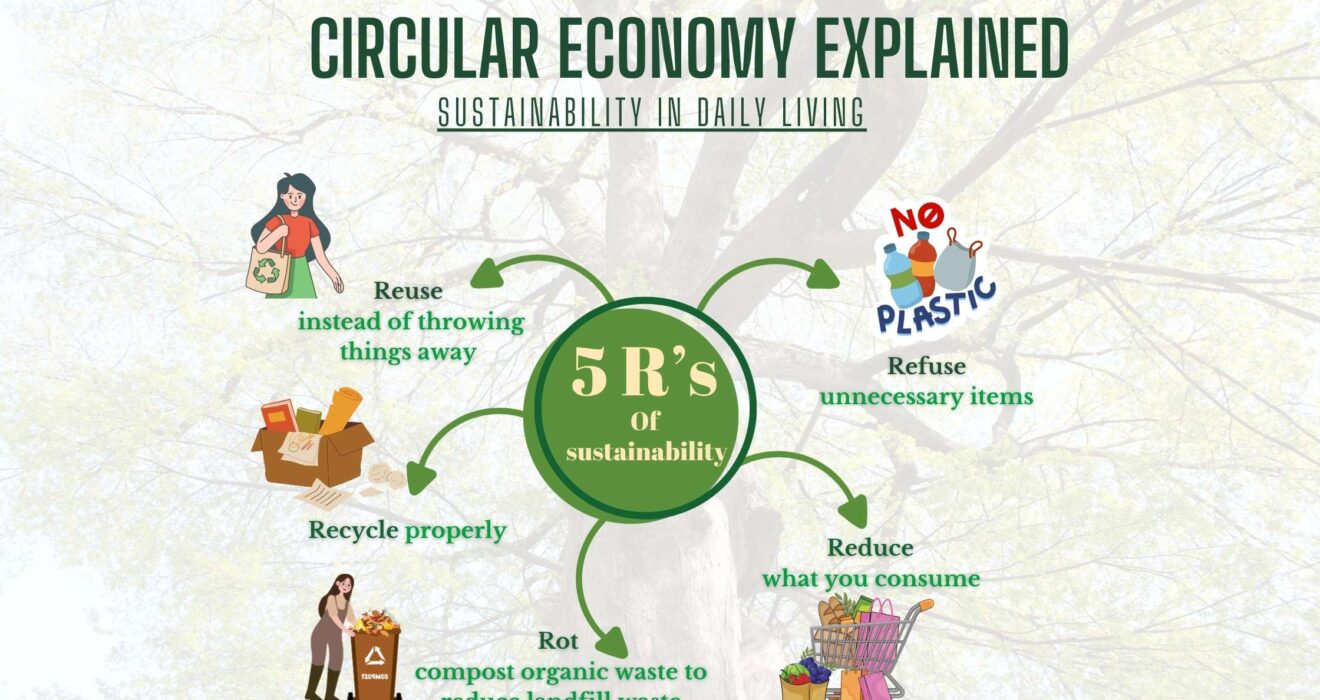
Recycling is a good start. But it is only one piece of a much larger picture. The 5Rs — Refuse, Reduce, Reuse, Recycle, and Rot — offer a more complete framework for living sustainably. They move us away from the habit of consuming and discarding, and toward something better: a circular relationship with the resources our planet provides.
1. Refuse — The Most Powerful R
The most effective way to deal with waste is to prevent it from existing in the first place.
Every time you decline a plastic bag you didn’t need, say no to a disposable straw, or choose a product with less packaging, you are sending a signal. Demand shapes supply. When enough people stop accepting unnecessary waste, industries stop producing it.
Start here:
- Carry a reusable bag — make it a habit, not a decision
- Decline single-use plastics at restaurants and shops
- Avoid products with excessive or non-recyclable packaging
- Think twice before accepting promotional items you will never use
As the saying goes: the least wasteful product is the one that was never made.
2. Reduce — Consume Thoughtfully
We live in a world designed to make us buy more than we need. Reducing is about stepping back and asking a simple question: do I actually need this?
Overconsumption depletes natural resources, drives greenhouse gas emissions, and fills landfills with goods that had years of life left in them. Choosing to consume less — and to consume better — eases that pressure at every point in the chain.
Practical steps:
- Buy durable, quality products that last rather than cheap ones that don’t
- Plan meals ahead to cut food waste at home
- Switch off lights, appliances, and taps when not in use
- Choose digital over print where you have the option
These are small shifts. But when adopted by millions of people, their cumulative effect is enormous.
3. Reuse — Before You Throw, Think Again
Before something goes in the bin, ask: can this be used again?
Reusing extends the life of products, reduces the demand for new materials, and keeps valuable resources in circulation rather than in the ground. It is also, in most cases, the cheapest and most immediate form of sustainability available to us.
Examples worth trying:
- Refill a reusable water bottle instead of buying bottled water
- Store leftovers in glass jars rather than single-use plastic containers
- Repair clothing and shoes instead of replacing them
- Donate what you no longer use so others can benefit from it
- Borrow tools, equipment, or books rather than buying new ones
Every item reused is one fewer item that needs to be manufactured, transported, and eventually disposed of.
4. Recycle — Give Materials a Second Life
When an item can no longer be refused, reduced, or reused, recycling is the next best option.
Paper, glass, metal, and many plastics can all be processed back into raw materials and made into new products. This reduces the pressure on forests, mines, and quarries, and the energy cost of extraction. Recycling is not perfect, but it matters.
To recycle effectively:
- Sort waste correctly; contaminated recycling often ends up in landfill anyway
- Rinse containers before placing them in the recycling bin
- Follow your local guidelines, which vary by area and material type
- Choose products made from recycled materials when available
One important note: recycling works best as the last resort, not the first response. It is far more effective when combined with refusing, reducing, and reusing upstream.
5. Rot — Return Organic Waste to Nature
The fifth R is the one most people overlook, and one of the most powerful.
Food scraps, fruit peels, coffee grounds, dry leaves, and garden trimmings do not belong in a landfill. When organic waste decomposes in landfill, it produces methane, a greenhouse gas far more potent than carbon dioxide. When composted properly, that same waste becomes something valuable: rich, fertile soil amendment that nourishes plants and restores the earth.
Why composting matters:
- Reduces methane emissions from landfills
- Builds healthier, more fertile soil
- Supports stronger crops, trees, and gardens
- Returns nutrients to the land rather than losing them to waste
Think of food scraps not as rubbish, but as resources still in the cycle. That shift in perspective, from waste to value, is at the heart of sustainable living.
Why the 5Rs Matter Together
Each R builds on the last. Together, they form the foundation of a circular economy — a system where resources are kept in use for as long as possible, and waste is minimised at every stage.
By making the 5Rs a daily habit, we can:
- Reduce pollution across land, water, and air
- Conserve forests, minerals, and water resources
- Lower carbon emissions that drive climate change
- Protect the biodiversity that healthy ecosystems depend on
- Support communities that are more resilient and more self-sufficient
These principles also directly support landscape restoration. Every time we refuse unnecessary consumption, reuse what we already have, and compost organic waste, we reduce the pressure on natural systems that need space and time to heal.
Every Choice Counts
Sustainability is not about being perfect. It is about being intentional, making slightly better choices today than you did yesterday, and slightly better ones again tomorrow.
Whether it is refusing a plastic straw, repairing an old jacket, composting vegetable peelings, or simply buying less, every action adds up. None of it is too small to matter.
At Hearts of Green, we believe that environmental stewardship starts with the individual. Restoration happens at scale — but it begins at home, in kitchens, in shopping trolleys, and in the small daily decisions that define how we live.
Refuse. Reduce. Reuse. Recycle. Rot.
Five habits. One healthier planet.
#HeartsOfGreen #LandscapeRestoration #SustainableLiving #5Rs #GreenKenya
